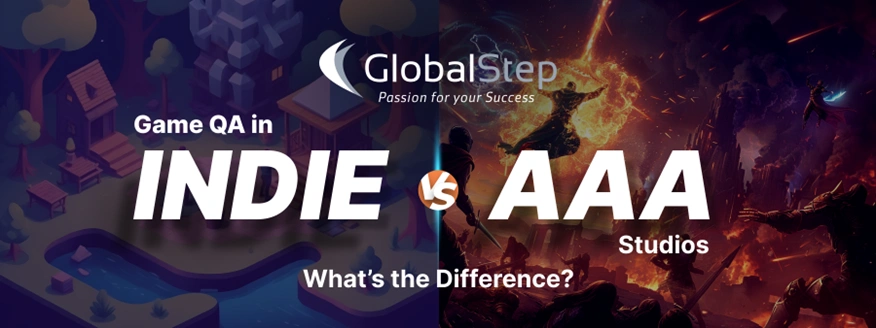
Game QA in Indie vs. AAA Studios: What’s the Difference?

Share Via:

Quality Assurance (QA) can make or break a game’s launch. The process, however, is not a “one size fits all” situation; it varies a lot between indie studios and AAA giants, impacting developers, publishers, and players. 

The Scope and Scale of Testing 

In AAA studios, a dedicated QA team is essential due to the huge size of projects. Hundreds of testers work on different aspects to ensure every detail is perfect. They check performance across platforms and complex systems, like AI behavior and network stability. This level of testing is critical for games played by millions worldwide. 

Indie studios have smaller teams with limited budgets; QA might be handled by just a few video game testers, or even the developers themselves. Focus is on core gameplay mechanics and stability rather than extensive platform testing, unlike AAA studios. This can mean some issues only show up once players get their hands on the game. 

Resource Allocation 

Resource allocation in Quality Assurance is another major difference between AAA and indie studios. AAA studios invest heavily in advanced tools, automated frameworks, and multiple playtesting rounds, allowing them to catch bugs early and refine the video game continuously. 

Indie studios, on the other hand, may not be able to afford such luxury, though it is advisable that they do so. They tend to only test on the launching phase and take feedback from users to pinpoint errors. While this type of action is fairly risky, it is often the only possible one, since the budget is almost always a decisive factor. 

Flexibility vs. Structure 

Flexibility is one of the major assets of indie studios. The advantage with small teams is that they are able to reverse and handle any problems that may occur. This agility allows indie developers to adapt to change easily without being required to undergo a lot of bureaucratic processes, as seen in big companies. 

AAA studios, on the other hand, work with a very defined QA procedure that can include several checks prior to the implementation of changes. This structure guarantees that testing has been completed and that risks have been reduced, but at the same time it poses a major inconvenience in the development cycle for immediate changes, making it very hard to address last-minute problems that may arise. 

The Role of Community 

In indie studios, community plays a vital role, and it includes Quality Assurance. Many indie developers even release their video games early to the public, in an effort to gain valuable feedback from players and consequently fix any bugs or issues that may arise. This approach is not only incredibly effective, but it also helps foster strong developer-player connections. 

AAA studios value player feedback too, but use formal channels like closed betas or external QA firms for bug identification, ensuring the game is ready and polished before its official release. Therefore, AAA studios rely less on community, given the availability of internal resources, unlike in indie studios. 

Conclusion: a Tailored Approach 

In conclusion, the differences between AAA and indie studios boil down mainly upon resource availability and project goals. While AAA studios benefit from structure and extensive resources, indie studios leverage flexibility and player engagement, ensuring top notch quality and speedy delivery, regardless of the scale involved. 

At GlobalStep, we are well aware of the problems faced by indie as well as AAA game development companies. Our tailored, specialized approach ensures we meet the needs and expectations for every project, which allows us to deliver large-scale, AAA game testing for top-tier studios as well as deeply customized, affordable testing solutions for independent studios and mid-sized teams. As a company that specializes in the full video game development lifecycle, we help our clients deliver amazing gameplay experiences, no matter the scale or scope. 

Looking to enhance your game’s QA process? Explore our Game QA services and Localization Quality Assurance to see how we can support your development journey.
You might also want to check
Choosing the Right Game Art Partner for Seamless Workflow

Choosing the Right Game Art Partner for Seamless Workflow

In Part 1 of this blog series, we discussed how game art outsourcing is a strategic benefit for developers that value both quality and scaling. Part 2 then dissected the…
7 Key Factors for Evaluating a Game Art Partner

7 Key Factors for Evaluating a Game Art Partner

Developing art for a video game is a complex craft. It’s not just about making something look good, but translating your vision into a living, breathing world on screen. That…
Outsource to Outperform: How to Choose the Best Game Art Partner in 2025

Outsource to Outperform: How to Choose the Best Game Art Partner in 2025

Finding the right game art partner is no easy quest, and the success of your game could depend on it. In this two-part blog series, we’ll start by exploring why outsourcing is often the best choice, plus key models and benefits to consider before choosing a partner. Let’s get started!

The global gaming market is on track to exceed $363 billion by 2027. (UStimes) So, it goes without saying that making game art that stands out from the rest is a critical competitive advantage. Visuals aren’t just decoration — they form players’ first and lasting impressions. High-impact environments, memorable characters, and intuitive UI drive engagement and retention through thoughtful character design and overall game design.

Whether you’re an indie studio or an established publisher, augmenting your core art team with specialized partners lets you scale rapidly and control costs. But choosing the wrong partner can undermine your creative vision, slow your game development timeline, and ultimately your budget.

Partnering with the right game art team means balancing quality, speed, cost, and cultural fit — and that’s where GlobalStep’s nearly two decades of stylized-and-casual expertise ensures your project looks and plays exactly as you intend.

In-House vs. Outsourcing: Choosing the Right Model

To decide between in-house and game development outsourcing, compare the trade-offs below. An internal team offers full control and shared culture, while a game art outsourcing studio delivers on-demand game art services — from 2d game art outsourcing to 3d art services — with minimal overhead. Top game art outsourcing companies streamline art outsourcing and outsourcing game art so you scale fast without sacrificing quality.

 In-House TeamOutsourced Partner
Control & CultureDirect oversight, shared company values.Leverage established processes — vetted partners primed to learn and embody your team culture and adapts quickly to your priorities.
Upfront InvestmentVery high (hiring, benefits, workspace, training).Minimal — only pay for delivered assets, no long-term commitments or overhead.
Talent PoolA la carte talent pool but limited by local availability.Access to best-in-class specialists worldwide, across the style spectrum in 2D and 3D design from hand painted to PBR.
ScalabilitySlow, costly. Hiring/firing cycles can affect your PR.On-demand scaling — ramp team size up or down within days according to planned project milestones and seasonal needs.
Time to MarketLong ramp-up for recruitment and onboarding.Rapid kickoff via proven pipelines — start seeing concept art in weeks, not months.

Key Benefits of Outsourcing Your Game Art

  • Cost Efficiency: Some milestones are more intense than others. Increasing your internal headcount can slow down progress and be wasteful on low intensity cycles. Your funding can go farther when you supplemented (and boost) using scheduled spending per milestone.
  • Speed & Agility: Tap into ready-made teams with domain-specific pipelines — no onboarding lag. If your pipeline isn’t set, experts can design one that’s right for you.
  • Access to Innovation: Our varied experience gives us insight into various cutting-edge tools and workflows you get to use immediately.
  • Risk Mitigation: Shift responsibility for deadlines, quality assurance, and IP security to experts.


Now that we’ve covered why outsourcing is a smart move and how it supports your game development goals, stay tuned for Part 2 — where we break down the seven essential factors you should use to evaluate and choose the right game art partner.

Choosing the Right Game Art Partner for Seamless Workflow

Choosing the Right Game Art Partner for Seamless Workflow

In Part 1 of this blog series, we discussed how game art outsourcing is a strategic benefit for developers that value both quality and scaling. Part 2 then dissected the…
7 Key Factors for Evaluating a Game Art Partner

7 Key Factors for Evaluating a Game Art Partner

Developing art for a video game is a complex craft. It’s not just about making something look good, but translating your vision into a living, breathing world on screen. That…
Outsource to Outperform: How to Choose the Best Game Art Partner in 2025

Outsource to Outperform: How to Choose the Best Game Art Partner in 2025

Finding the right game art partner is no easy quest, and the success of your game could depend on it. In this two-part blog series, we’ll start by exploring why outsourcing is often the best choice, plus key models and benefits to consider before choosing a partner. Let’s get started!

The global gaming market is on track to exceed $363 billion by 2027. (UStimes) So, it goes without saying that making game art that stands out from the rest is a critical competitive advantage. Visuals aren’t just decoration — they form players’ first and lasting impressions. High-impact environments, memorable characters, and intuitive UI drive engagement and retention through thoughtful character design and overall game design.

Whether you’re an indie studio or an established publisher, augmenting your core art team with specialized partners lets you scale rapidly and control costs. But choosing the wrong partner can undermine your creative vision, slow your game development timeline, and ultimately your budget.

Partnering with the right game art team means balancing quality, speed, cost, and cultural fit — and that’s where GlobalStep’s nearly two decades of stylized-and-casual expertise ensures your project looks and plays exactly as you intend.

In-House vs. Outsourcing: Choosing the Right Model

To decide between in-house and game development outsourcing, compare the trade-offs below. An internal team offers full control and shared culture, while a game art outsourcing studio delivers on-demand game art services — from 2d game art outsourcing to 3d art services — with minimal overhead. Top game art outsourcing companies streamline art outsourcing and outsourcing game art so you scale fast without sacrificing quality.

 In-House TeamOutsourced Partner
Control & CultureDirect oversight, shared company values.Leverage established processes — vetted partners primed to learn and embody your team culture and adapts quickly to your priorities.
Upfront InvestmentVery high (hiring, benefits, workspace, training).Minimal — only pay for delivered assets, no long-term commitments or overhead.
Talent PoolA la carte talent pool but limited by local availability.Access to best-in-class specialists worldwide, across the style spectrum in 2D and 3D design from hand painted to PBR.
ScalabilitySlow, costly. Hiring/firing cycles can affect your PR.On-demand scaling — ramp team size up or down within days according to planned project milestones and seasonal needs.
Time to MarketLong ramp-up for recruitment and onboarding.Rapid kickoff via proven pipelines — start seeing concept art in weeks, not months.

Key Benefits of Outsourcing Your Game Art

  • Cost Efficiency: Some milestones are more intense than others. Increasing your internal headcount can slow down progress and be wasteful on low intensity cycles. Your funding can go farther when you supplemented (and boost) using scheduled spending per milestone.
  • Speed & Agility: Tap into ready-made teams with domain-specific pipelines — no onboarding lag. If your pipeline isn’t set, experts can design one that’s right for you.
  • Access to Innovation: Our varied experience gives us insight into various cutting-edge tools and workflows you get to use immediately.
  • Risk Mitigation: Shift responsibility for deadlines, quality assurance, and IP security to experts.


Now that we’ve covered why outsourcing is a smart move and how it supports your game development goals, stay tuned for Part 2 — where we break down the seven essential factors you should use to evaluate and choose the right game art partner.